 Book now
 The Best Time to Visit Malbork Castle
A month-by-month guide to weather, crowds, light and summer night tours at the largest brick fortress on earth.
Malbork Castle is open year-round, but the experience inside its 21 hectares of brickwork shifts dramatically across the seasons. The Teutonic Order's former capital sits on the east bank of the Nogat river in northern Poland, about an hour by train from Gdańsk on the Baltic coast, and its unheated brick interiors hold the cold of winter long into early summer. Crowd patterns are equally seasonal — the castle, operated by the Malbork Castle Museum, absorbs around 600,000 visitors a year, and the bulk of those arrive between mid-June and late August. This guide breaks down what each month delivers in weather, light and visitor density, when the summer night tours run, and the weekday rhythm that decides whether you share the Knights' Refectory with a coach party or have it almost to yourself.
How Poland's Baltic Climate Shapes a Malbork Visit
Malbork sits in Pomerania, the broad coastal plain south of the Gdańsk Bay. The climate is genuinely northern European maritime — summers are warm rather than hot, autumns are wet and atmospheric, winters are cold with the Nogat occasionally freezing at the margins. Average July highs sit in the low twenties Celsius, January averages hover around freezing, and rainfall is spread fairly evenly through the year with a modest summer peak. The factor visitors most consistently underestimate is the difference between outdoor and indoor temperature at the castle. The brick walls are roughly two metres thick in places and largely unheated, which means the High Castle chapter house, the Grand Master's Palace, and Saint Mary's Church remain notably cold even on warm summer days.
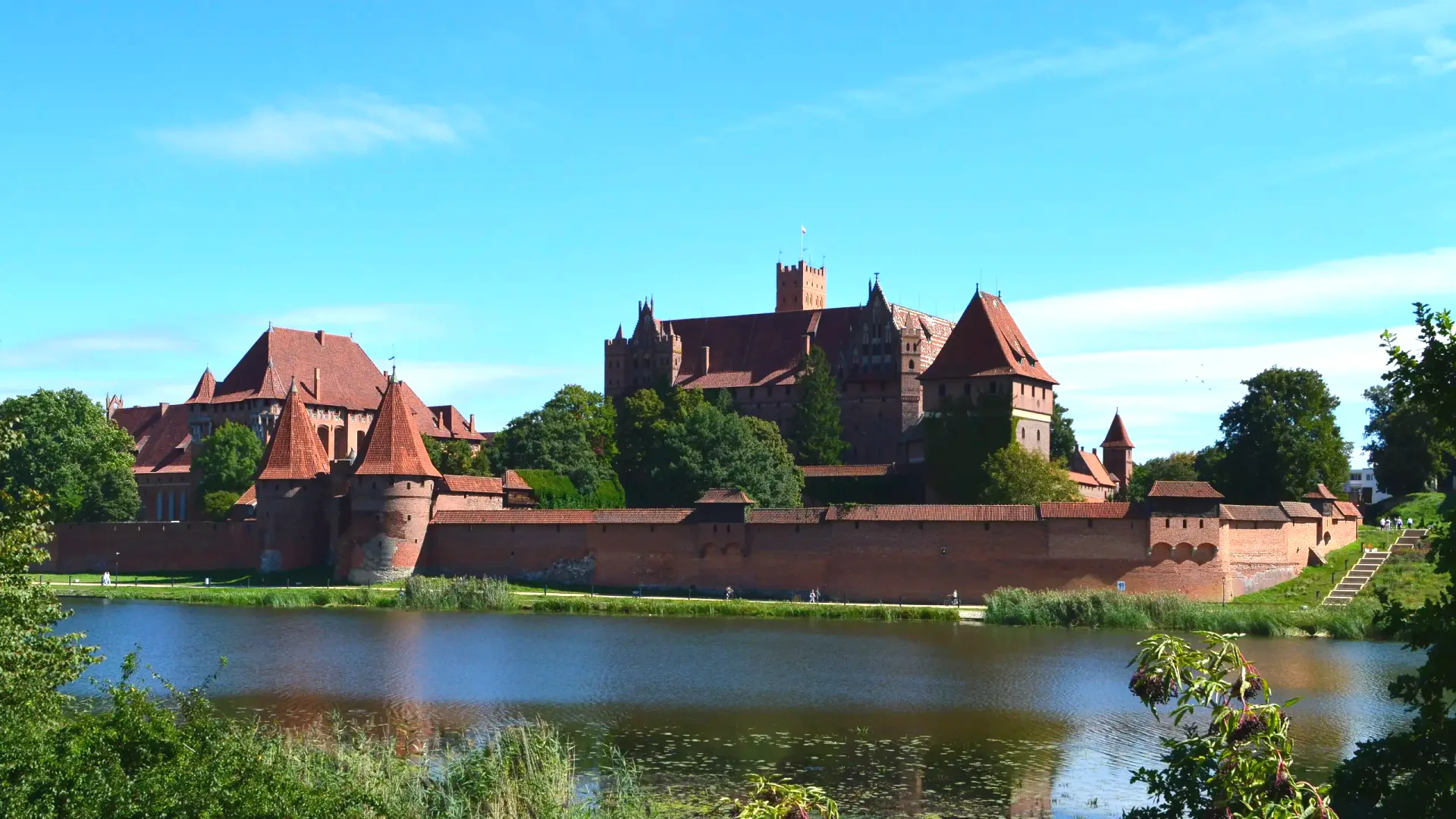
Practical implication: bring a warm layer year-round. A fleece or light jacket plus long trousers is enough between June and September. From October through May a proper coat is sensible, and in midwinter a hat and gloves make the indoor walk through the High Castle considerably more comfortable. Weather also shapes the iconic external view of the castle from the west bank of the Nogat. The mirrored reflection works best in still conditions — early mornings in summer or after a winter cold snap — and the red-brick walls take their warmest hue in late afternoon light from May to September. Storm fronts off the Baltic can move in quickly and add atmosphere rather than ruining the day.
Month-by-Month: What to Expect Across the Year
January and February are the quietest months of the year. Visitor numbers are at their lowest, no queues to speak of, and slots are easy to secure on the day. The trade-off is the short daylight window and properly cold interiors. March sees the castle still in winter operating mode but with lengthening days, and the first Polish-school excursions begin to appear from mid-month. April marks the transition into the spring schedule with longer hours and the first of the international coach traffic; visitor numbers climb steadily but the site is still calm by summer standards. Late April through May is one of the strongest combinations of mild weather, long days, and manageable crowds.
June, July and August are the peak. Daylight runs until nine or ten in the evening, night tours run after dark, and Polish family holidays plus international tourism push Saturday queues at the main gate to forty-five minutes on the busiest days. September is one of the most rewarding months — warm enough for shirtsleeves outside, crowd levels noticeably easing from mid-month, and the brick takes on a deep red tone in the lower-angled afternoon light. October offers atmospheric mist off the Nogat and dramatic skies for photography. November through February is the quiet, atmospheric off-season — book any slot, walk the courtyards with almost no one else there, and dress for genuine winter inside as well as out.
Peak Summer: The Saturday Bottleneck and How to Avoid It
On peak summer Saturdays in July and August, the on-the-day ticket queue at the main gate can run thirty to forty-five minutes, and the most popular morning time slots sell out before lunchtime. Coach groups from Gdańsk, Warsaw and the German Baltic coast converge on the same windows — broadly ten in the morning to two in the afternoon — and the Knights' Refectory and Grand Master's Palace can feel genuinely crowded inside. There are three reliable strategies to sidestep the bottleneck. The first is to arrive at opening time on a weekday: Tuesday through Friday outside school holidays delivers the calmest experience. The second is to book a timed slot in advance so there is no ticket to buy on the day.
The third strategy is to arrive in the late afternoon — typically after three o'clock — when the coach groups have already started their return journeys to Gdańsk for dinner. The castle stays open into the evening during peak season, the light on the brick walls is at its best, and a late-afternoon visit pairs naturally with a summer night tour for visitors willing to make a full day or evening of it. Whatever the strategy, peak-summer Saturday mornings are the single least pleasant window of the year to arrive without a booking. Sunday mornings are slightly easier, weekday mornings significantly easier, and any visit between Tuesday and Friday outside Polish school holidays sees a noticeably different castle.
Weekly Rhythm and Polish School Holidays
Malbork's visitor flow is uneven across the week. Saturdays and Sundays are consistently the busiest days in peak season, with Saturday slightly heavier due to combined day-trip traffic from Gdańsk, Warsaw and the German coast. Tuesday through Friday is the quietest window, particularly outside Polish school holidays. Mondays in shoulder and winter season may have reduced hours or full closure — always confirm Monday opening on the operator's current schedule before planning that day. Polish school holiday periods compress crowd density into mid-week as well: the long summer break from late June to early September, the Easter break in March or April, and the Christmas and New Year window all raise weekday numbers substantially.
If your itinerary is flexible, a Wednesday or Thursday in May, June or September is the highest-value combination of light, mild weather and manageable crowd density. If you can only travel on a summer weekend, book a slot for the first hour after opening or after three in the afternoon — these are the two windows that consistently sit outside the heaviest pressure. The Sintra-style weekend-Tuesday cruise effect that hits some European sites does not apply at Malbork in the same way — cruise traffic from Gdynia is a factor on summer Saturdays, but Tuesdays here are typically among the calmest days of the week.
Frequently asked
What's the single best month to visit Malbork Castle?
May and September deliver the strongest combination of mild weather, long daylight, and manageable crowds. June is close behind. July and August offer the warmest weather and summer night tours, but bring the heaviest queues.
Is Malbork worth visiting in winter?
Yes, with the right expectations. Winter delivers the quietest castle of the year, atmospheric mist off the Nogat, and almost no queues, but interior temperatures are genuinely cold and daylight is short. Bring a proper coat, hat and gloves, and plan to be inside by mid-afternoon.
Which day of the week is busiest at Malbork?
Saturday in peak summer (July and August) is consistently the busiest single day. Sundays are second-tier. Tuesday through Friday outside Polish school holidays are noticeably calmer.
Is the castle open every day of the year?
Malbork is open year-round on a three-tier seasonal schedule. The site closes on a small set of major public holidays including New Year's Day, Easter Sunday, and Christmas Day, and Monday opening can vary in winter — always check the current schedule before travelling.
How cold does it get inside the castle in winter?
Interior temperatures track outside temperatures with only a few degrees buffer because the castle is largely unheated. On a sub-zero January day expect the High Castle chapter house and the Knights' Refectory to feel cold enough that you'll photograph your own breath.
Is mid-summer too hot for a long walking visit?
Rarely. Peak July afternoons in Malbork average around twenty-three to twenty-five degrees Celsius, and the castle interiors stay cool even on warm days. The bigger summer factor is sunshine on the cobbled courtyards — bring water and a hat for the outdoor sections.
What about Polish public holidays?
Polish national holidays — particularly the May 1 and May 3 long weekend, August 15, and November 1 — push domestic visitor numbers sharply higher. If your dates fall on these weekends, book a slot well in advance and prioritise an early-morning or late-afternoon entry.
Is the photography light best at a particular time?
Late afternoon, year-round. The classic shot from the west bank of the Nogat works best when the sun is low in the west and the red brick takes its warmest tone. From May to September this means roughly an hour before sunset; in winter, mid-afternoon.
Can I see the castle in fewer than three hours?
Realistically no. The Standard interior route runs three to four hours including the audio guide, and the courtyards add time on top of that. Visitors who try to compress the visit consistently report leaving with the sense of having rushed past the rooms most worth standing inside.