 Book now
 The Grand Masters of Malbork: Monk-Princes of the Baltic
For a century and a half, the most powerful monastic state in history was governed from a brick palace on the Nogat. These are the men who ruled it — and the rooms where they did it.
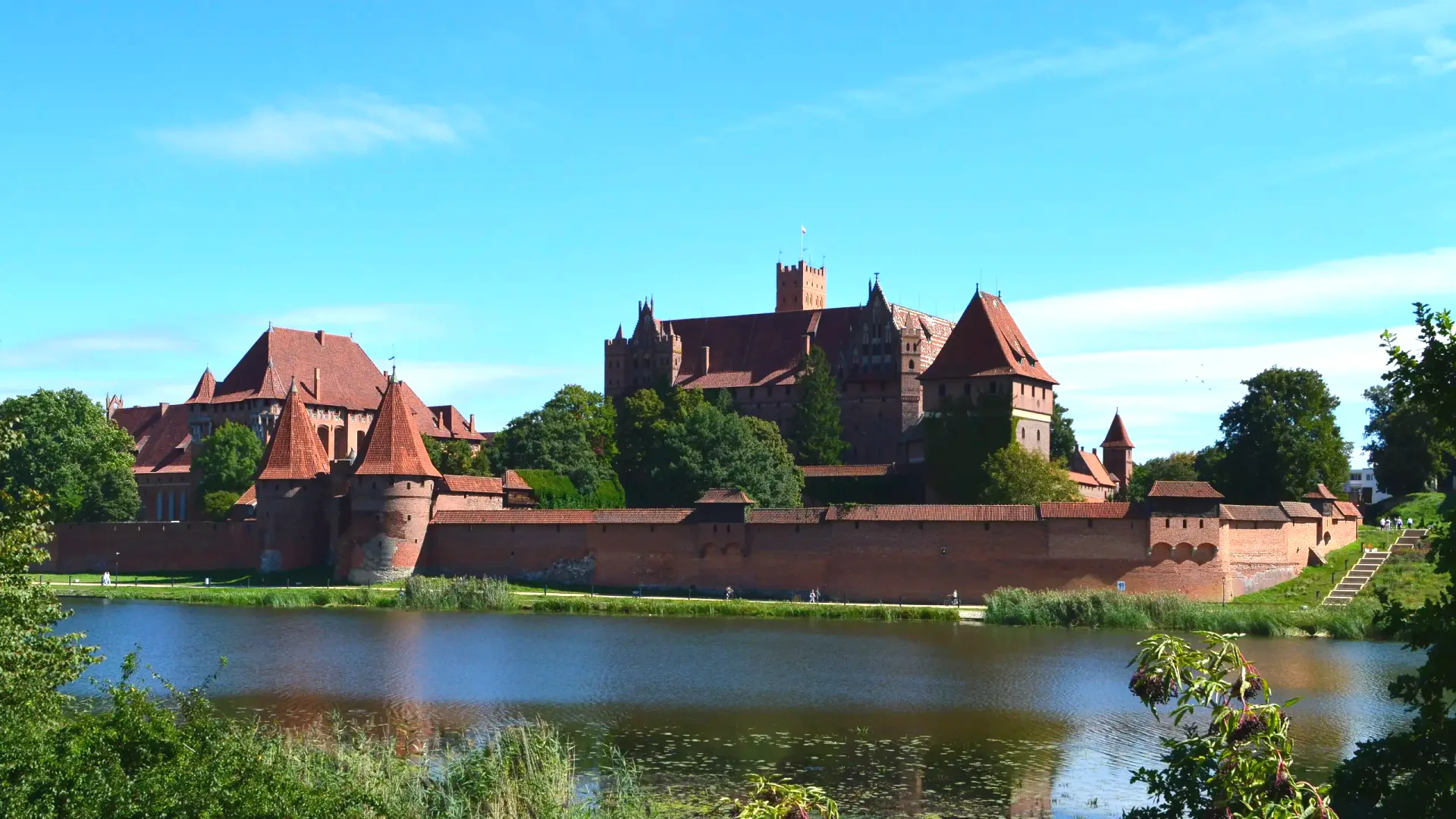
Malbork Castle is often introduced by its statistics — the largest castle in the world by land area, outer walls enclosing roughly twenty-one hectares — but the numbers only make sense once you understand who needed a building this size and why. From 1309 to 1457 the castle was the capital of the Teutonic Order's monastic state in Prussia: a polity run not by a king but by an elected Grand Master, a man who was simultaneously the abbot of a religious brotherhood, the commander of a crusading army, and the chief executive of one of medieval Europe's most sophisticated economies. UNESCO's citation calls the castle-convent an embodiment of 'the drama of late medieval Christianity, straining between extremes of sanctity and violence,' and the Grand Masters lived exactly on that fault line. This guide traces the five men whose tenures defined Malbork — the one who brought the capital here, the one who presided over the golden age, the one who died at Grunwald, the one who saved the castle, and the one who lost it without a siege — and shows you where their story is still legible in the rooms you walk today.
1309: Siegfried von Feuchtwangen Moves the Capital
The Teutonic Order did not begin on the Baltic. It was founded as a German hospitaller brotherhood in the crusading Levant, and by the start of the fourteenth century its leadership was seated, improbably, in Venice. The move that created Malbork as the world knows it came under Grand Master Siegfried von Feuchtwangen, who held office from 1303 to 1311: in 1309 he transferred the Order's headquarters from Venice to the fortress the brothers called Marienburg — Mary's castle — on the east bank of the Nogat. Tradition records his ceremonial entry with his knights on 14 September 1309. What had been a regional commander's castle, under construction in stages since about 1280, was suddenly the capital of a state.
The timing was strategic. The Order had just consolidated its grip on Gdańsk and the surrounding territory, and its centre of gravity now lay unambiguously in Prussia, where its crusades against the pagan Prussians and Lithuanians — and its collisions with the Christian Kingdom of Poland — were concentrated. A capital on the Nogat placed the Grand Master in the middle of his own commercial and military network rather than at the end of a long line from the Adriatic. The consequence for the building was immediate and dramatic: the castle was, in UNESCO's words, 'substantially enlarged and embellished after 1309,' growing over the following century into the tripartite complex of High Castle, Middle Castle and Outer Bailey that survives today.
Feuchtwangen's move also fixed the castle's strange double identity. The High Castle remained what it had always been — the principal monastery of the Teutonic convent in Prussia, a quadrilateral stronghold built around a conventual chapel dedicated to the Virgin Mary, with dormitories, a chapter house and a refectory arranged like any great abbey. But grafted onto the monastery was now the apparatus of a government: treasuries, chanceries, guest quarters for visiting princes, and eventually a purpose-built palace for the Grand Master himself. No other building in Europe fused the two functions on anything like this scale, which is precisely why UNESCO judged it 'a unique, perfectly planned architectural creation, with no equivalent in Gothic architecture.'
The Palace of a Monk-Prince
The Grand Master was an elected monk sworn to the rule of his order, yet he received kings, ran a state and commanded armies — and his residence had to say all of that at once. The answer was the Grand Master's Palace in the Middle Castle, which UNESCO singles out, together with the Great Refectory beside it, as one of the two 'masterpieces of Gothic architecture' within the complex. The palace's showpiece interiors — the Summer Refectory above all, with its vaulting gathered onto a single slender granite pillar — were engineered to impress ambassadors and creditors as much as to house a churchman. This was diplomacy conducted in brick.
Around the palace, the Middle Castle worked as the state's public face. The Great Refectory could seat the Order's assembled dignitaries and noble guests of the famous Prussian 'table' journeys; chambers for the Grand Commander and an infirmary filled out the wings; and the whole ensemble was buffered from the outside world by the Outer Bailey — a working district of walls, moats, towers and service buildings, including the armoury known as the Karwan. One architectural signature deserves a special look as you walk: the Dansker, the latrine tower set apart from the main block on its own gallery. UNESCO notes it was first developed at Malbork and then copied across the castles of the monastic state — sanitation as an export product.
For today's visitor, the power structure maps cleanly onto the route. The High Castle is the monastery: chapter house, dormitories, the Church of the Virgin Mary. The Middle Castle is the government: palace, Great Refectory, reception chambers. The Outer Bailey is the logistics: storage, workshops, defences. Walk it in that order with the audio guide — included with standard Historical Castle Route admission and available in eleven languages — and the castle stops being a maze and becomes an organisational chart in brick.
Winrich von Kniprode and the Golden Age
If one tenure defines Malbork at its zenith, it is Winrich von Kniprode's, who ruled as Grand Master from 1351 to 1382 — three decades that coincide with the Order's period of greatest influence and territorial reach in Prussia. The fourteenth century was when the monastic state matured from a crusading frontier into a governed economy: planned towns, granaries, tolls and a trading network plugged into the Hanseatic world. UNESCO's synthesis dates the state's peak influence squarely to this century, and it was from Malbork's chanceries that the machine was run.
Kniprode's Malbork was also a court in the full chivalric sense. The Order's wars against pagan Lithuania drew crusading nobility from across Europe, and hosting them — feasting them in the great refectories, honouring them at tournaments — was part of the state's soft power. The castle's architecture of hospitality, from the Great Refectory to the guest chambers of the Middle Castle, is the physical residue of that diplomacy. When you stand in the Great Refectory, you are standing in what was effectively the banqueting hall of a multinational military alliance, maintained by a brotherhood of monks.
The golden age carried the seeds of the crisis that followed. The Order's neighbours were consolidating: Poland and Lithuania would shortly be joined under a single dynasty, converting the Order's crusading rationale into a strategic encirclement. The state Kniprode perfected — wealthy, bureaucratic, superbly fortified — was about to face a war it could not win in the field, and the castle he embellished would have to do what castles are ultimately for.
1410: Grunwald, the Siege, and Heinrich von Plauen's Hour
On 15 July 1410, at Grunwald, the combined forces of Poland and Lithuania destroyed the Order's field army in one of the largest battles of medieval Europe. Grand Master Ulrich von Jungingen, in office since 1407, died on the field along with much of the Order's leadership. Militarily, the state was decapitated in an afternoon; the road to Marienburg lay open, and the victorious armies marched on the capital expecting to end the Order's rule in Prussia at a stroke.
That they did not is owed to Heinrich von Plauen, a commander who was not yet Grand Master when he threw himself into the castle with what garrison he could gather and organised its defence. The Siege of Marienburg in the late summer of 1410 held; the fortifications did their work; and the besieging armies eventually withdrew. Plauen was elected Grand Master in the aftermath and held office until 1413, when the Order's internal politics deposed him — a reward that says as much about the brotherhood's factionalism as the defence says about his nerve. The castle had saved the state, and bought it another half-century.
The 1410 drama is the narrative spine of a Malbork visit today. The audio guide that comes with standard admission is built around the experience of the siege, voiced and dramatised as it steers you through the key rooms. If the Grand Masters' story hooks you, give the Middle Castle extra time — the walls make a better storyteller than any plaque.
1457: The Capital Sold, Not Stormed
The end, when it came, was a transaction rather than a battle. The Thirteen Years' War against Poland and its Prussian allies drained the Order's treasury until it could no longer pay the Bohemian mercenaries garrisoning its fortresses — including Marienburg itself. By 1456 the financial position was hopeless, and in 1457 the unpaid mercenaries resolved the matter commercially: the castle passed to King Casimir IV of Poland, who entered the capital that the armies of 1410 had failed to take. Grand Master Ludwig von Erlichshausen, in office since around 1450, abandoned the fortress his predecessors had ruled for a century and a half, and the Order's seat moved east to Königsberg.
Malbork's second life began at once. From 1457 the castle served as a residence of the kings of Poland, and from 1466 it housed the authorities of Royal Prussia. Over the following three centuries it accumulated new institutional tenants: the Polish Admiralty from 1568, a royal mint established in 1584, and the largest arsenal in the Polish-Lithuanian Commonwealth. The monastery-state capital had become a working royal complex — less glamorous, perhaps, but continuously useful, which is often what saves great buildings. Only with the Prussian seizure of 1772 did the decline into military warehouse and, eventually, near-ruin begin.
For the visitor, 1457 is the hinge that explains the castle's layered character: a Teutonic convent wrapped in a Polish royal residence wrapped in a Prussian monument wrapped in a modern museum, established in 1961. The Grand Masters' century and a half remains the deepest layer and the one the restoration has most carefully recovered — which is why walking from the High Castle's chapter house through the palace's refectories still reads, seven centuries on, as a tour of a functioning medieval government.
Frequently asked
Who moved the Teutonic Order's capital to Malbork?
Grand Master Siegfried von Feuchtwangen, who transferred the Order's headquarters from Venice to Marienburg in 1309 — tradition records his entry with his knights on 14 September that year. The castle then served as the seat of the Grand Masters and the authorities of Teutonic Prussia until 1457.
Which Grand Master ruled during Malbork's golden age?
Winrich von Kniprode, Grand Master from 1351 to 1382. His three-decade tenure coincided with the monastic state's period of greatest influence in the fourteenth century, when the castle functioned as the capital of a wealthy, highly organised Baltic power.
What happened to the Grand Master at the Battle of Grunwald?
Ulrich von Jungingen, Grand Master from 1407, was killed at Grunwald on 15 July 1410 when Polish-Lithuanian forces destroyed the Order's field army. Heinrich von Plauen then organised the successful defence of the castle in the siege that followed, was elected Grand Master, and was deposed in 1413.
Why did the Order lose Malbork without a siege in 1457?
Bankruptcy. Exhausted by the Thirteen Years' War, the Order could not pay the Bohemian mercenaries garrisoning the castle, and in 1457 the fortress passed to King Casimir IV of Poland, with Grand Master Ludwig von Erlichshausen withdrawing to Königsberg. Malbork then served the Polish crown for over three centuries.
Can you visit the Grand Master's Palace today?
Yes — the palace and the Great Refectory, the two interiors UNESCO singles out as Gothic masterpieces, are on the Historical Castle Route, which covers the castle's interiors and exhibitions. The included audio guide, available in eleven languages, walks you through them with the story of the 1410 siege as its narrative thread.
What is the Dansker tower?
The Order's characteristic latrine tower, set apart from the main castle on its own gallery. UNESCO notes the design was first developed at Malbork and subsequently copied at other castles across the monastic state — a small but telling example of how this castle set the pattern for an entire building tradition.