 Book now
 How to Get to Malbork Castle from Warsaw
Direct express trains put the largest brick castle on earth just over two hours from Warszawa Centralna. Here is how the corridor actually runs — and how to build a day around it.
Most visitors assume Malbork Castle belongs exclusively to a Gdańsk itinerary, and most guides are written that way. In fact the castle sits directly on the Warsaw–Gdańsk main line, which means every express heading for the Baltic coast passes through Malbork station — and a Warsaw day trip is not just possible but genuinely comfortable. On the current timetable the fastest services cover Warszawa Centralna to Malbork in about two hours and seven minutes, running direct, with departures spread through the day at a broadly hourly rhythm. That is a shorter run than many of the day trips Varsovians make without a second thought, and at the far end waits the former capital of the Teutonic Order: twenty-one hectares of Gothic brick above the Nogat river, a UNESCO World Heritage Site since 1997. This guide covers the trains as they actually run, the walk from Malbork station to the castle gate, how to time your entry slot around the castle's opening rhythm, and the fallback options if the railway does not suit.
Why the Train Beats Everything Else on This Corridor
The Warsaw–Gdańsk line is the flagship of the Polish rail network, and Malbork is one of its regular calling points. Three service tiers matter to a castle visitor. At the top are the EIP services — the Pendolino trains — which on the current timetable make Warszawa Centralna to Malbork in two hours and seven minutes, direct, no changes. EIC expresses run to essentially the same timing. Below them sit the standard IC trains, which take around two hours and forty-five minutes and typically cost less. All three categories run directly through Malbork; you step off the train roughly fifteen minutes' walk from the castle gate.
Checked on the live timetable for a typical late-August weekday, the pattern is unmistakable: EIP departures leave Warszawa Centralna at twenty-nine minutes past the hour through the morning and afternoon — the 09:29 arrives at 11:36, the 10:29 at 12:36, the 11:29 at 13:36 — while IC services fill the gaps from one minute past the hour, arriving around two hours and forty minutes later. Exact minutes shift with each timetable revision, so verify your specific date on the PKP Intercity site or app before committing, but the structure — direct, roughly hourly, all day — has been stable and is what makes the Warsaw day trip work.
The alternatives compare poorly. Driving means several hours each way on motorway and national roads, then hunting for limited metered parking near the castle — an option that only earns its keep if you are stringing together several Pomeranian stops in one swing. Long-distance coaches exist but are slower than any rail option and drop you no closer to the gate. There is no airport logic either: Malbork's nearest major airport is Gdańsk, which simply puts you on the same rail line from the other end. For a single-destination castle day from Warsaw, the train wins on every axis that matters — speed, comfort, and arrival position.
Booking Trains: Timing, Seats and the Departure That Matters
Book the outbound leg in advance. The premium expresses on this line are popular with business traffic to the Tricity as well as tourists, and the best-value fares are released ahead of travel on intercity.pl and the PKP Intercity mobile app. Booking early matters most for summer weekends, when coastal holiday traffic fills the Pendolinos, and for the key morning departures a castle visitor actually wants. Buying on the day usually still works, but you may find yourself on a later or slower service than the plan below assumes.
The departure that matters is the morning express that lands you in Malbork before noon. On the current pattern that means leaving Warszawa Centralna at or before half past nine: the 09:29 EIP puts you in Malbork at 11:36, which — after the walk to the gate — has you entering the castle a little after midday, with the museum's own recommended minimum of three and a half hours comfortably in hand before the Historical Castle Route's last entry at half past four in the afternoon during the spring–summer season. Earlier departures exist for those who want the castle at its quietest; later ones start to squeeze the visit. In the autumn–winter season (1 October 2026 to 25 April 2027) the day is much shorter: last entry to the Historical Castle Route is 12:45 and the interiors and exhibitions close at 15:00, so in that season take an earlier departure that has you at the gate by mid-morning.
For the return, the same line runs services back to Warsaw through the late afternoon and evening. Rather than pre-committing to a tight return, many visitors buy a flexible or later return so the castle sets the pace rather than the timetable. If you do fix a return, allow the fifteen-minute walk back to the station plus a margin — Malbork station is small and easy to navigate, but an express missed by two minutes is still missed. Check the evening departures for your specific date when you book the morning leg, and note the last workable connection somewhere you will actually look at four in the afternoon.
From Malbork Station to the Castle Gate
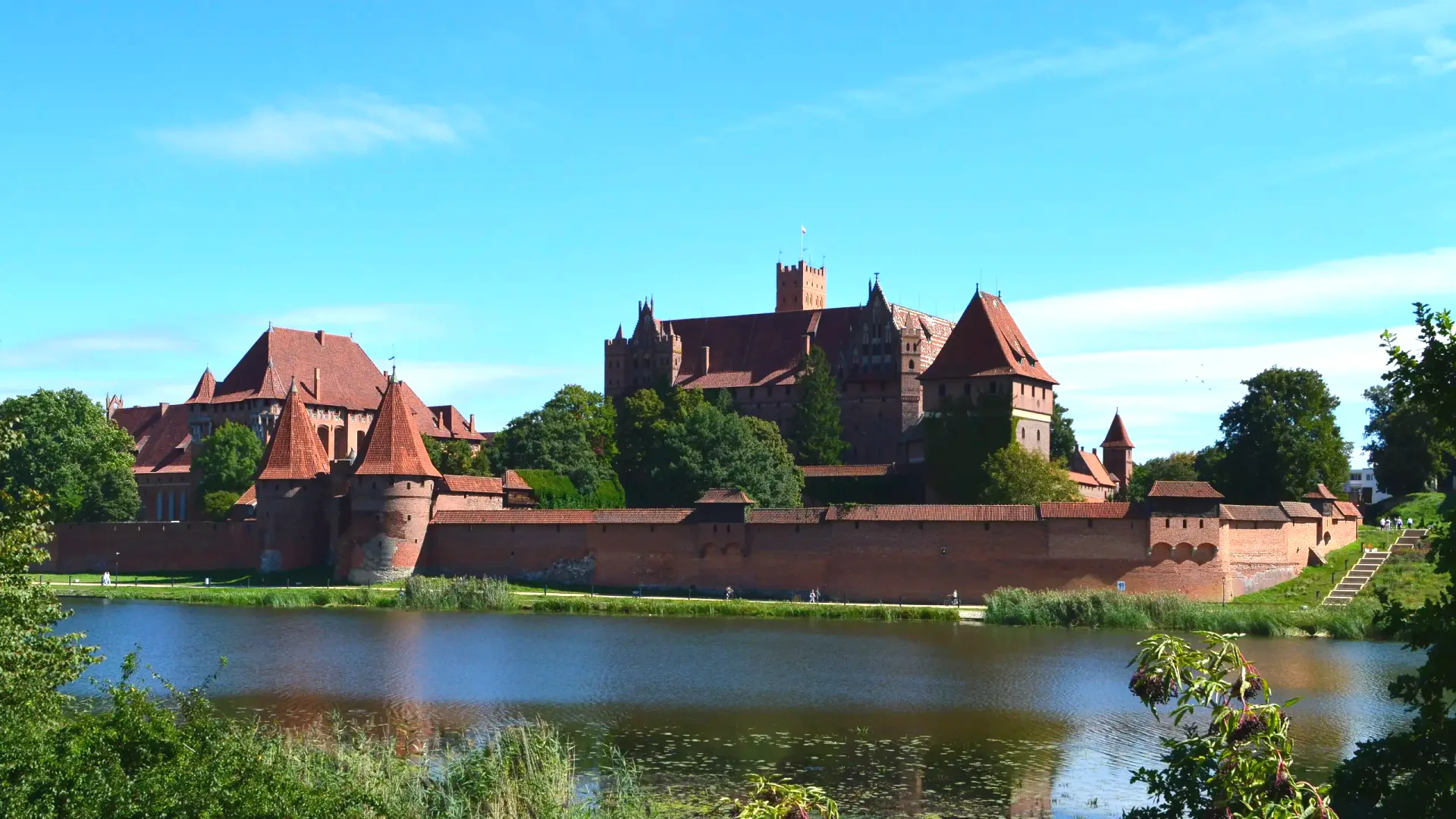
The walk from Malbork station to the castle's main gate takes about fifteen minutes at an unhurried pace, flat the whole way. Leave the station forecourt and follow ulica Dworcowa and then ulica Kościuszki through the modern town centre — a handful of cafés and bakeries along the way solve the early-lunch problem — and the route delivers its reward as you approach the Nogat: the full western panorama of the castle rising above the river, the view that has anchored paintings and photographs of Malbork for two centuries. It is worth building five spare minutes into the plan purely to stop on the bridge.
Taxis wait at the station for anyone who prefers to skip the walk — worthwhile in heavy rain, with reduced mobility, or with small children at the end of a long morning. Inside the castle grounds, remember the museum's rules: large luggage and big backpacks are not allowed on the routes, and free lockers are provided in the ticket office building. If you are travelling onward rather than returning to Warsaw — continuing to Gdańsk for the night, say — plan around a compact bag you can lock away rather than a full suitcase.
One rhythm note for the return walk: late afternoon light on the west-facing river front is the best of the day from spring to early autumn, so the bridge view is often better on the way out than on the way in. Photographers deliberately schedule their departure to cross the Nogat in that window. If you have thirty minutes before your train, the riverside path on the west bank extends the panorama and costs nothing but the detour.
Timing the Castle: Entry Windows, Opening Rhythm and the Monday Trap
Malbork runs on timed admission, and the mechanics matter for a day-tripper. When you book a slot for the castle, the time on your ticket is a thirty-minute admission window — a period during which you present yourself at the gate — not the start time of a guided tour. Arrive within your window, clear the entry checks, and from there the pace is yours: the audio guide included with standard Historical Castle Route admission runs about two hours if you follow it straight through, and the museum itself advises allowing no less than three and a half hours for the full visit. Guided departures in Polish leave every thirty minutes for those who prefer a human guide; the audio guide is available in eleven languages, English included.
The castle's day has a firm architecture in the spring–summer season, which in 2026 runs from late April to the end of September: the Historical Castle Route operates Tuesday to Sunday from nine in the morning, with last entry at 16:30 and interiors closing at 19:00. From 16:45 the shorter Castle Grounds Route takes over, with last entry at 18:30 and the grounds open until 20:00. Working backwards from the 16:30 cut-off and the three-and-a-half-hour minimum, a Warsaw day-tripper wants to be at the gate by 13:00 at the very latest — which is exactly what the 09:29 express delivers, with margin. In the autumn–winter season (1 October 2026 to 25 April 2027) the day is much shorter: last entry to the Historical Castle Route is 12:45 and the interiors and exhibitions close at 15:00, and the grounds route runs 13:00–16:00 with last entry at 14:30 — so an autumn or winter day-tripper from Warsaw needs to be at the gate by mid-morning.
The Monday trap catches Warsaw day-trippers more than anyone. On Mondays only the Castle Grounds Route is available — courtyards, terraces, moats and fortifications, with none of the interiors that make Malbork extraordinary — offered free with passes collected at the ticket office. A Monday visit still shows you the scale of the place, but the chapter house, the Grand Master's Palace and the great vaulted refectories all stay shut. If your Warsaw schedule has any flexibility at all, spend it moving Malbork to a Tuesday-to-Sunday slot. The museum also closes fully on a handful of public holidays, including New Year's Day, Easter Sunday, All Saints' Day and the Christmas period, so check the calendar for edge dates.
Beyond the Day Trip: Overnights and Two-City Plans
The Warsaw day trip works, but Malbork rewards visitors who refuse to rush it. Staying overnight in Malbork town unlocks the experience a day-tripper usually sacrifices: the night tour that the museum runs for individual visitors from the start of May to the end of August — roughly ninety minutes through courtyards, cloisters and selected interiors after dark, with English-language departures on summer Fridays. It ends well after the last comfortable express back to Warsaw, and it transforms the castle from a museum into a place.
The other high-value pattern is the triangle: Warsaw to Malbork by morning express, the full castle visit, then a short onward hop to Gdańsk for one or two nights before returning to Warsaw. The onward leg is trivial — express services cover Malbork to Gdańsk in under half an hour, with regional trains as backup — and it converts a long out-and-back into a proper northern loop that adds the Hanseatic old town, the Motława waterfront and the Baltic coast for the price of one extra hotel night. If Malbork is the reason you are heading north, this is the itinerary that honours it.
Whichever shape you choose, book the castle slot before you book the train. Summer morning windows are the ones under pressure, and a secured admission window turns the rest of the logistics into simple arithmetic: count back two and a quarter hours for the express, fifteen minutes for the walk, and a small buffer for coffee. Done in that order, the largest brick castle on earth is one of the easiest big-ticket day trips in Central Europe.
Frequently asked
How long is the train from Warsaw to Malbork?
On the current timetable the fastest direct EIP and EIC expresses take about two hours and seven minutes from Warszawa Centralna, while standard IC services take around two hours and forty-five minutes. Departures run at a broadly hourly rhythm through the day, and no change of train is needed.
Is Malbork Castle really doable as a day trip from Warsaw?
Yes, comfortably — if you take a morning express. Leaving Warszawa Centralna at or before about half past nine puts you at the castle gate a little after midday, which leaves more than the museum's recommended minimum of three and a half hours before the Historical Castle Route's last entry at 16:30 in the spring–summer season. In the autumn–winter season (1 October 2026 to 25 April 2027) the day is much shorter: last entry to the Historical Castle Route is 12:45 and the interiors and exhibitions close at 15:00, so take an earlier train that puts you at the gate by mid-morning.
Do I need to book the train in advance?
It is strongly advisable for the key morning expresses and for summer weekends, when Baltic holiday traffic fills the Pendolino services. Advance booking on intercity.pl or the PKP Intercity app also secures the better fares. Same-day tickets usually exist, but often on later or slower departures than a castle day wants.
How do I get from Malbork station to the castle?
It is a flat walk of about fifteen minutes: follow ulica Dworcowa and ulica Kościuszki through the town centre and cross the Nogat bridge, which serves up the castle's famous western panorama on the way. Taxis wait at the station for anyone who prefers to ride.
What does the entry time on a castle ticket actually mean?
It is a thirty-minute admission window — the period in which you present yourself at the gate — not the start of a guided tour. Once inside you explore at your own pace; the included audio guide takes about two hours to follow, and the museum advises at least three and a half hours for the full visit.
Should I avoid visiting on a Monday?
If you can. On Mondays only the Castle Grounds Route is open — free, with passes collected at the ticket office — which covers courtyards, terraces and fortifications but none of the interiors. The full Historical Castle Route runs Tuesday to Sunday.