 Book now
 Ruin and Resurrection: How Malbork Castle Was Destroyed and Rebuilt
More than half the castle was rubble in 1945. What you walk today is one of the great conservation feats in Europe — and knowing the story changes what you see.
Every visitor to Malbork walks through a paradox. The castle is celebrated as the most complete and elaborate example of a Gothic brick castle complex in the style of the Teutonic Order — UNESCO's own words — yet in 1945 more than half of it was destroyed in the final fighting of the Second World War. The building you tour is simultaneously a medieval original and a twentieth-century resurrection, and the reason that sentence is not a contradiction is the castle's other, quieter claim to fame: Malbork is where much of modern conservation practice was invented. Techniques worked out here in the nineteenth century became standard across Europe, and the meticulous records those early conservators left behind became the blueprint that made the post-war rebuilding honest rather than invented. UNESCO inscribed the castle on the World Heritage List in 1997 partly for exactly this — calling it 'a historic monument to conservation itself.' This guide tells that story in five acts: the long decline, the nineteenth-century rescue, the catastrophe of 1945, the decades of rebuilding, and how to read the seams between old brick and new as you walk the routes today.
Decline: From Royal Residence to Prussian Warehouse
The castle's slide began with a change of flag. After serving the kings of Poland from 1457 and housing the institutions of Royal Prussia — an admiralty, a mint, the Commonwealth's largest arsenal — the complex was seized by the Kingdom of Prussia in the partition of 1772. Stripped of its royal function, the great buildings were treated as the Prussian state treated most conveniently massive structures: as barracks and storehouses. Alterations in this period were brutal by any later standard, with Gothic interiors subdivided, vaults cut through, and windows reshaped for utility. By the turn of the nineteenth century the former capital of the monastic state was, functionally, a warehouse with a remarkable silhouette.
The rescue began as a Romantic cause. From the early nineteenth century, German Romanticism discovered in Marienburg a symbol of medieval grandeur, and the first restoration campaign ran from 1817 to 1842. It was well-meaning, occasionally fanciful, and — crucially — it established the principle that the castle was a monument to be studied rather than a quarry to be used. UNESCO's assessment notes that since the second half of the eighteenth century Malbork has been 'one of the major sources of fascination with European medieval history,' and honestly adds the darker corollary: the castle's modern history also 'illustrates the tendency to treat history and its monuments as instruments in the service of political ideologies.' Every regime that held Malbork read its own story into the brick.
That ideological weight matters for understanding everything that followed. For nineteenth-century Prussia and later for imperial Germany, the restored Marienburg was pressed into service as a national symbol of medieval German expansion eastward — pageantry, imperial visits and commemorations were staged against its walls. The same symbolism is precisely what made the castle's fate after 1945 so uncertain, and what makes the decision Poland eventually took about the ruins so remarkable. A building can survive artillery more easily than it survives being a symbol; Malbork, almost uniquely, survived both.
The Scientific Restoration, 1882–1944
The second restoration campaign, running from 1882 until 1944, was a different animal altogether. This was conservation as a discipline: systematic archaeology of the fabric, painstaking documentation of every wall and vault, and reconstruction grounded in evidence from the building itself. In the course of the work, as UNESCO records, 'many forgotten medieval art and craft techniques were rediscovered' — brickmakers, masons and glaziers relearning how their fourteenth-century predecessors had actually worked, because the building demanded it. Methods evolved at Malbork in these decades passed into the general practice of European conservation; the castle was a laboratory as much as a monument.
The showpieces of this era are still the interiors that stop visitors today. In the High Castle, the Chapter House with its accurately reconstructed vaulted ceiling — into which surviving medieval details were, in UNESCO's phrase, 'impeccably fitted' — along with the Grand Masters' sepulchral chapel, the kitchen, dormitories and refectory. In the Middle Castle, the early twentieth-century campaigns restored St Catherine's Chapel, St Bartholomew's Chapel, the Grand Commander's chambers and the infirmary, and rebuilt parts of the Outer Bailey including St Lawrence's Chapel and the New Gate. Walking these rooms, you are looking at two crafts at once: medieval building and nineteenth-century conservation, each executed at the top of its game.
The campaign's most consequential product, though, was paper. Decades of measured drawings, photographs and written records accumulated into one of the most complete documentation archives any great building possessed. Nobody involved could know it, but they were writing the insurance policy for a catastrophe none of them would live to see.
1945: More Than Half the Castle Destroyed
In the final stage of the Second World War, the front reached the Nogat. The fighting of early 1945 was catastrophic for the castle: more than half of the complex was destroyed, with the damage concentrated where the shelling came from — the eastern side took the worst of it, and the conventual Church of the Virgin Mary, the spiritual heart of the High Castle, was left in ruins. The town of Malbork around it suffered comparably. Where the sieges of the fifteenth century had failed, twentieth-century artillery succeeded in weeks.
The photographs from the immediate post-war years show something close to a lost cause: collapsed vaults, towers sheared open, the church a roofless shell. The castle now stood in a Poland whose borders had moved west, inheriting a monument built by a German crusading order — a building whose previous custodians had celebrated it as a symbol of everything the new custodians had just survived. That Poland chose to rebuild it anyway, and to rebuild it faithfully, is the least appreciated decision in the castle's history, and the one on which everything a visitor sees today depends.
What survived mattered as much as what fell. The western ranges facing the Nogat — the panorama the world knows — came through in far better condition than the shattered east, and the two interiors UNESCO would later single out as Gothic masterpieces, the Grand Master's Palace and the Great Refectory, endured to anchor the restoration. Just as importantly, the documentation archive of the pre-war conservators survived the war. The building had lost half its fabric but almost none of its knowledge, and that asymmetry is the entire story of the decades that followed.
Rebuilding: 1947 to the Church's Completion in 2016
Reconstruction began in 1947, initially as securing and clearance, and gathered institutional permanence when the Malbork Castle Museum was established in 1961, with comprehensive restoration running continuously from the early 1960s onward. The method is what makes Malbork's rebuild internationally admired: rather than inventing a plausible medieval castle, the restorers worked from the vast documentation archive of the 1882–1944 campaign, reinstating what the records could prove. UNESCO's authenticity assessment makes the point explicitly — the post-war reconstruction is 'characterised by the great care which was taken to use the extensive and detailed records' of the earlier conservators, which is why the castle could be inscribed on the World Heritage List with its authenticity rated very high.
The work was generational. Vaults were re-turned, the eastern ranges raised again, exhibitions installed as sections came back into service, and the castle grew into its present role as one of Poland's most visited monuments — the museum now absorbs visitor numbers on the order of six hundred thousand a year. The final great milestone came astonishingly recently: the full restoration of the conventual Church of the Virgin Mary, the building left ruined in 1945, was completed in April 2016. A visitor in the 1990s saw a castle still carrying open war wounds at its core; a visitor today sees the complex whole for the first time in living memory.
It is worth pausing on the date. Seventy-one years separate the destruction from the church's completion — longer than the original construction campaigns that raised the High Castle. Conservation at this scale is not an event but an institution, and it continues: sections of the complex still close periodically for works, which is why one of the museum's routes can be temporarily unavailable in any given season. When a scaffolded wall interrupts a photograph, it is the same discipline that saved the building doing its ordinary work.
Reading the Seams: What to Look For on Your Visit
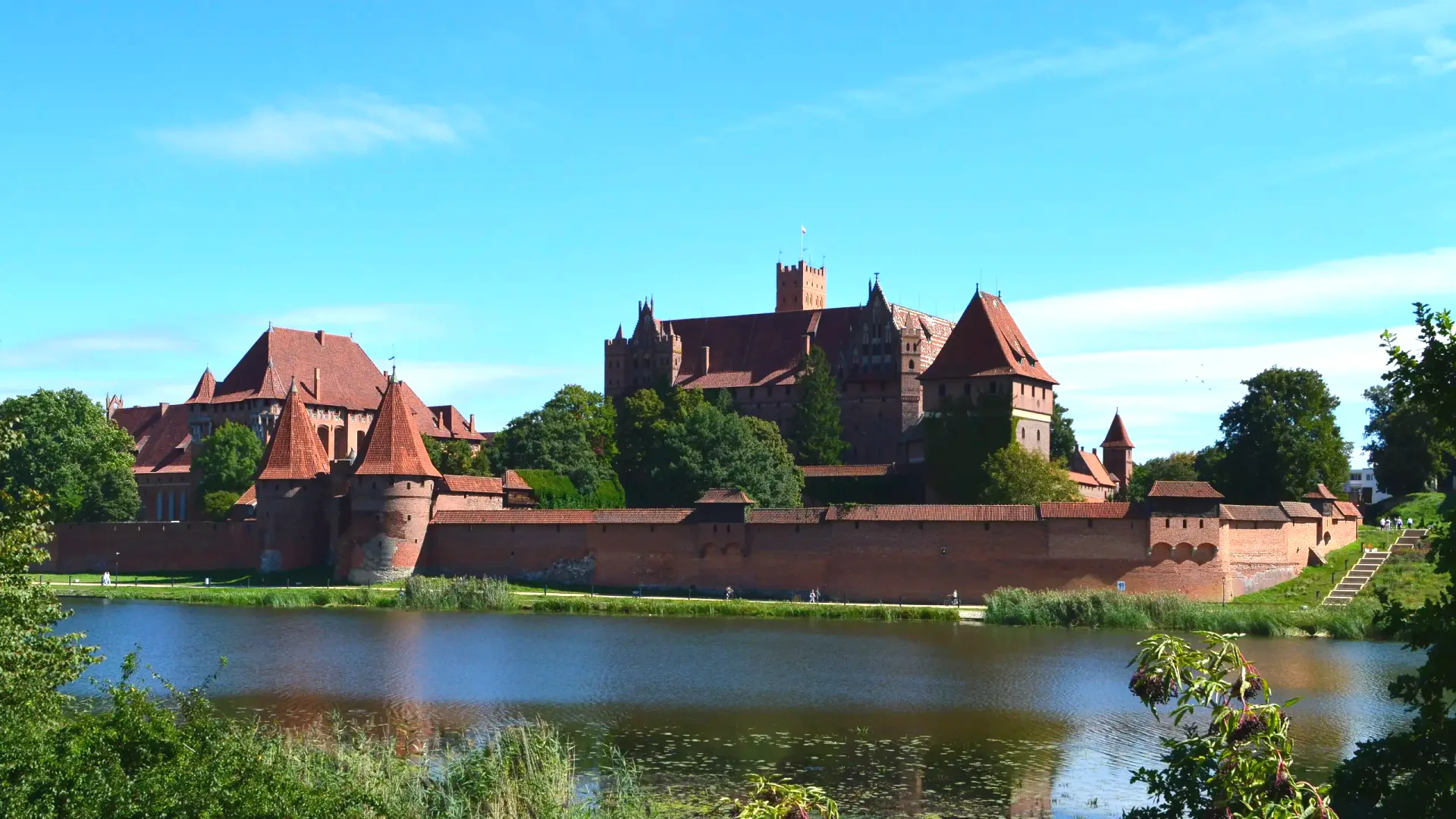
Once you know the story, the castle becomes legible in a new way. Look for the transitions in the brickwork: medieval brick, nineteenth-century replacement brick and post-war brick differ subtly in colour, surface and coursing, and long façades often carry all three within a single field of wall. The restorers made no secret of the layering — the point was fidelity to evidence, not forgery — and part of the pleasure of a slow visit is learning to spot where one era hands over to the next. The western river front, the picture-postcard panorama, reads as seamless from across the Nogat; up close, it is a manuscript with corrections.
Prioritise the rooms where the conservation story is richest. The High Castle's Chapter House shows the nineteenth-century method at its most virtuosic — a reconstructed vault carrying genuine medieval details. The Church of the Virgin Mary shows the twenty-first-century chapter, restored within living memory and reading differently again. The Grand Master's Palace and Great Refectory, the two interiors UNESCO names as masterpieces, survived and were restored to carry the castle's ceremonial narrative. The audio guide included with Historical Castle Route admission threads many of these spaces together in about two hours; give the full visit the museum's recommended three and a half hours or more if the fabric itself is what you have come for.
And end across the river. The west-bank panorama at golden hour is the classic photograph, but after this chapter of the story it is something better: a view of the most painstakingly resurrected great building in this part of Europe, indistinguishable at distance from the skyline the Grand Masters knew. UNESCO inscribed Malbork in December 1997 under criteria that honour not only the medieval achievement but the conservation that carried it into the present. Both achievements are standing in the same walls.
Frequently asked
How badly was Malbork Castle damaged in the Second World War?
Severely — more than half of the castle complex was destroyed in the fighting of 1945, with the eastern side worst hit and the conventual Church of the Virgin Mary left in ruins. The damage came in the final stage of the war, and reconstruction began in 1947.
Is what I see at Malbork today original or rebuilt?
Both, in honest layers. Substantial medieval fabric survives — including the Grand Master's Palace and Great Refectory — alongside major nineteenth-century restorations and the large post-1945 reconstruction, which followed the detailed records of earlier conservators. UNESCO rates the castle's overall authenticity as very high precisely because the rebuilding was evidence-based.
When was the reconstruction finished?
In one sense, astonishingly recently: the restoration of the Church of the Virgin Mary, ruined in 1945, was only completed in April 2016. In another sense it is never finished — conservation at Malbork is a permanent institution, and sections of the complex still close periodically for ongoing works.
Why is Malbork's conservation history part of its UNESCO listing?
Because conservation practice itself was partly developed here. The campaigns of 1817–1842 and especially 1882–1944 rediscovered forgotten medieval craft techniques and pioneered methods that became standard across Europe, and their documentation made the faithful post-war rebuild possible. UNESCO, which inscribed the castle in 1997, calls it 'a historic monument to conservation itself.'
Can you still see traces of the destruction today?
In the details, yes. Differences in brick colour and coursing mark the boundaries between medieval, nineteenth-century and post-war fabric, and the museum's displays cover the destruction and rebuilding. The complex as a whole, however, now stands complete — the first time in living memory that has been true.